(14/12/2010) SANT'AGATA DI PUGLIA LOCALITA' DA VISITARE di Redazione | ||
 | ||
Distanza dal capoluogo: Km. 48, Abitanti: 2323,Cap: 71028,Supeficie: Kmq 116,Altitudine: 794 m.s.l.m.
Sito web ufficiale: www.ilsantagatese.it
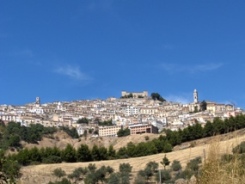
Immaginate un tronco di piramide, e tutt’attorno centinaia di case, minuscole, altre più ardite con qualche raffinatezza architettonica. E immaginate di trovarvi, sul calar della sera, di fronte ad un presepio, con tante luci a far da scenario magico. Questa è Sant’Agata di Puglia,certamente uno dei paesi più suggestivi della provincia foggiana.Dall’alto dei suoi quasi 800 metri si domina uno dei paesaggi più strepitosi del Tavoliere. Sulla cima del paesello sorge una rocca militare (da molti chiamato anche castello) che i romani vollero a difesa della zona. Naturalmente nel tempo quell’impianto è andato via via deturpandosi ed oggi sono visitabili solo i resti, compresa una cinta muraria che attesta l’importanza storica e strategica di quella costruzione.Sant’Agata nei secoli ha subìto numerosi dominazioni, assedi e contaminazioni. Ed anche di fronte a personaggi di fama ma sanguinari - come il mitico Capitano Agatone, duca di Capua - i suoi abitanti non mancarono di coraggio e ardimento. Proprio contro Pandolfo IV (appunto il duca di Capua), che impose una legge a dir poco squallida e iniqua (pretendeva che ogni donzella appena maritata trascorresse con lui la prima notte di nozze...), il malcontento del popolo trovò proprio nel barbiere del paese il giustiziere che pose fine alla barbarie: alla prima occasione utile, l’uomo non ci pensò due volte a decapitare il malvagio padrone. L’immagine di Agatone, accompagnata dalla scritta “Meglio morire che disonorarsi”) comparve molti secoli dopo all’ingresso della Rocca. Sant’Agata è dunque paese antico e fu certamente crocevia di diverse civiltà come testimoniano i resti ancora ben visibili nella piana sottostante: il ponte romano a tre arcate sul fiume Calaggio, la vicina caserma romana (denominata “Horatianum”) per il cambio dei cavalli che più tardi fu trasformata in convento monastico e che divenne fermata obbligatoria per i Crociati che si dirigevano verso oriente. Il poeta latino Orazio in una satira, nel descrivere il suo viaggio verso Brindisi, cita anche questa zona: infatti la strada col ponte romano sul Calaggio conduceva - come diramazione interna - verso la via Appia, che il poeta percorse insieme all’amico Mecenate per recarsi in Grecia.La rocca, che per interessamento di Federico II rientrò nel nòvero delle sue mete residenziali preferite, divenne reggia e nel 1386 fu anche teatro di una seduta del Parlamento del Regno Angioino.Tutto il paese merita una visita ma quel che affascina di più è indubbiamente il vero centro storico, costituito da minuscole strade di accesso, palazzi gentilizi, numerosi archi e soprattutto chiese antichissime come quella di S. Andrea Apostolo, del sec. VII ma ricostruita nel 1542, che contiene vere preziosità: i due altari in pietra rossa, la statua della Madonna di Costantinopoli del 1300 e quella dell’Aiuto del 1700, il coro tardorinascimentale riccamente intagliato, il crocifisso ligneo del 1600. In un’altra chiesa, quella di S. Michele Arcangelo, edificata ad opera dei Longobardi, è presente un bellissimo trittico della fine del 1300 che viene attribuito alla scuola del Beato Angelico.Tra i reperti antichi, merita una citazione l’antico frantoio del ‘500, ottimamente conservato. Interessante è pure la Chiesa Madre intitolata a San Nicola, costruita in stile barocco. Al suo interno un pulpito ottagonale in granito rosa, il bellissimo coro del 1700 e diversi dipinti tra i quali la Pala di San Gaetano ed altre tele dedicate alla Madonna, datate fra il XVI e il XVII secolo. Luoghi di interesse turistico: Castello Imperiale; Borgo Medioevale; Parco urbano delle opere in pietra; Chiesa Sant'Agata; Palazzo Volpe; Palazzo de Marinis Calcagno; Palazzo Capria; Palazzo Torraca; Palazzo Vinciguerra; Palazzo Barbato; Ponte romano sul Calaggio.
Per Informazioni:Comune: tel. 0881/984007 - fax 0881/984084 ________________________________________ Imagine a frustum of pyramid and all around small houses, together with more audacious ones, with some architectural refinements. And imagine you are, at sunset, in front of a crib with so many lights acting as a magic background. This is Sant’Agata di Puglia, certainly one of the most suggestive villages in the province of Foggia. From the height of its about 800 metres, you can overlook one of the most striking landscapes in Tavoliere. On the top of the village stands out a military fort (which is commonly called Castle) the Romans built to defend the area. Naturally in the course of centuries that foundation has more and more deteriorated and today only its remains including a boundary wall witnessing the historical and strategic history of that building are visible. Origins In the course of centuries Sant’Agata di Puglia has undergone numerous dominations, sieges and contaminations. And even in front of such renowned but bloodthirsty characters – as the mythical Captain Agatone, the duke of Capua – its inhabitants didn’t lack courage and boldness. Just against Pandolfo IV (the duke of Capua himself) who imposed quite a wretched and unfair law (he expected every freshly married maid to spend the first wedding night with him …), the population’s discontent found in the village barber the executioner who put an end to the barbarism: on the first good occasion the man beheaded the wicked lord resolutely. Agatone’s image with the inscription “It is better to die than dishonour oneself” appeared at the fort entrance many centuries later. Therefore, Sant’Agata is an ancient village and was certainly the crossroads of many civilizations as the still well-visible remains in the plain below witness: the three-arched Roman bridge over the river Calagio, the nearby Roman barracks (called “Horatianum”) for the change of horses which later on was turned into a monastic convent and which became a compulsory halt for the Crusaders who went eastwards. Horace, the Latin poet, in a satirical poem, while describing his journey to Brindisi, quotes this district too: as a matter of fact the road with the Roman bridge over the Calagio led – as inner branch – towards the Appian Way on which the poet travelled together with his friend Maecenas to go to Greece. The fort, which was one of the favourite residential destinations of Frederic II, through his offices became royal palace and in 1836 took in a session of the Parliament of the Angevin Kingdom. Art and Culture The whole village is worth visiting, but what fascinates most is, certainly, the real historical centre, consisting of small entrance streets, gentilitial palaces, numerous arches and above all very old churches such as St. Andrew Apostle’s, dating back to the seventh century but rebuilt in 1452, housing true affectations of refinements: the two red stone altars, the statue of the Madonna of Constantinople of 1300 and the Madonna of the Aid’s of 1700, the richly carved late Renaissance choir, the wooden crucifix of 1600. St. Michael Archangel church, built by the Longobards, houses a wonderful triptych of the end of 1300 which is attributed to the school of the Beato Angelico. Among the ancient findings, the old olive mill of ‘500, perfectly preserved is worth pointing out. The Mother Church devoted to St. Nicholas, built in Baroque style is noteworthy, too. Its inside houses an octagonal pulpit in pink granite, the beautiful choir of 1700 and several paintings among which St. Gaetano Altar-Piece and other paintings devoted to the Madonna dated between the sixteenth and seventeenth centuries. Sights Castle; Medieval hamlet; Works in stone; Urban Park; St. Agatha Church; Volpe Palace; de Marinis Calcagno Palace; Capria Palace; Torraca Palace; Vinciguerra Palace; Barbato Palace; Roman Bridge over the Calaggio. tratto da www.dauniadafavola.it
| ||